
Every lender compares three months' interest against an interest rate differential and charges whichever is greater, but the law only sets that outline. The comparison rate, the variable-rate formula, and whether a five-year cap applies are choices each lender makes on its own. BrokerPlus prices each one against its own disclosed method rather than one generic formula, which is why an identical mortgage can price very differently from one lender to the next.
Why Lenders Differ
The Interest Act only forces the greater-of comparison. Beyond that, a lender picks its own comparison rate and its own variable-rate formula. BrokerPlus tracks these differences lender by lender rather than assuming one bank's method applies everywhere.
Finding the Rule Behind Your Result
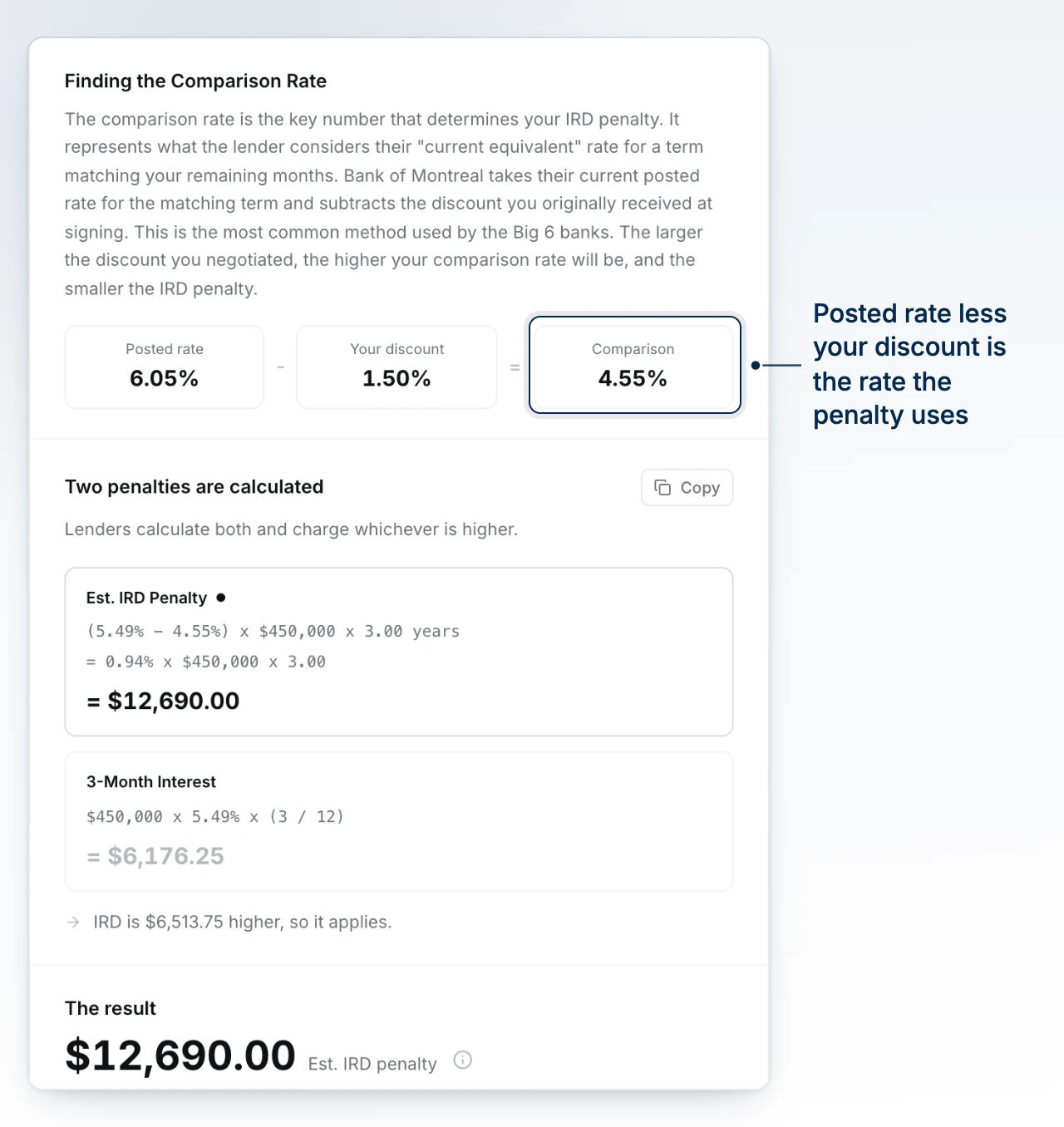
Open the calculation explainer on a result, the panel showing how the lender calculates your penalty, to see which comparison rate applies and how it was derived. A figure priced from a lender's own published disclosure is sourced; one resting on a generic posted-rate comparison because BrokerPlus has no lender-specific curve for that institution is an estimate, and the panel says so. Treat an estimate as a ballpark and confirm the exact number against the lender's own payout statement.
The Common Departures
Most Big Six banks compare your rate to their posted rate today, minus the discount you received at signing. CIBC, National Bank and Laurentian price it differently: they measure the gap between the posted rate the day you signed and the posted rate today, so the figure moves with how rates shifted since signing rather than with your discount. Monoline lenders such as First National, MCAP, Merix, Manulife, CMLS and RFA compare your rate against what the lender would reinvest at today for a mortgage of your remaining length, which keeps the number closer to three months' interest more often than a posted-rate method does. Equitable Bank and Bridgewater compare against the Government of Canada bond yield for your remaining term, which tends to run higher. A mortgage past its fifth year, at a federally regulated lender whose original term ran longer than five years, is capped at three months' interest by law no matter what the differential would otherwise be.
Variable and Open Mortgages
A variable mortgage only ever faces the three-months'-interest penalty, since there is no fixed rate to run a differential against, but even that isn't uniform. TD, CIBC and National Bank price it off their posted prime rate rather than your own contract rate. EQ Bank scales the months instead of using a flat three: five in the first year of the term, four in the second, three from the third year on. Haventree does not offer a variable product at all. An open mortgage carries no penalty either way.
When Your Lender Is Not Listed
A reverse mortgage's real penalty follows a declining percentage-of-balance schedule BrokerPlus does not model; the figure shown is a three-month floor that understates an early payout. A private lender or MIC is assumed to charge three months' interest, typical but not a disclosed rule. An unresolved lender name falls back to the standard bank method rather than something riskier, and the result is flagged as an estimate. Add the lender under its own name once you have its actual terms, so future results stop resting on that fallback.
What to Do Next
Return to Run a Prepayment Penalty Calculation to price a client's actual numbers, or read Understand Interest Rate Differential Math for how the underlying formula is built.